
Last Updated: October 2026
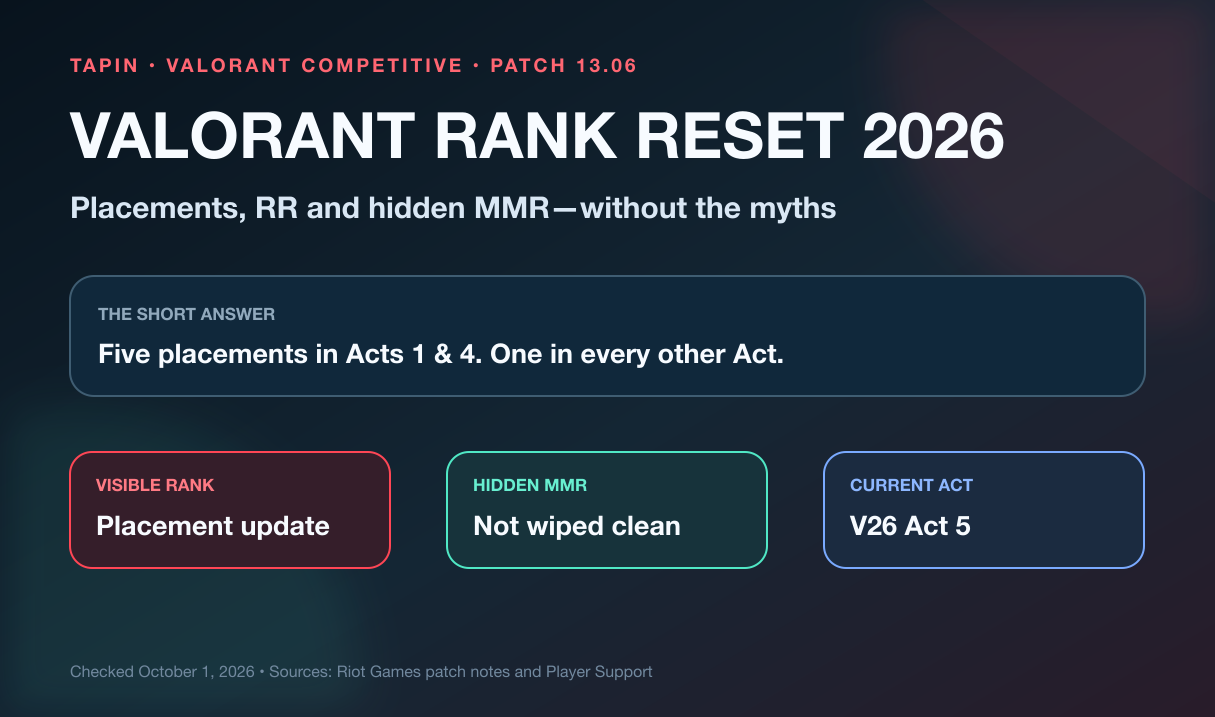
The Valorant rank reset is not the same at the start of every Act. Riot uses five placement matches at the start of the Season and Mid-Season, then one placement match at the start of the other four Acts.
That distinction matters right now. Valorant is in V26 Act 5 on Patch 13.06{:target="_blank"}, so returning ranked players who already completed the 2026 reset need one placement—not a five-game grind.
For a duo, the useful goal is not “beat the reset.” Keep your roles, two core calls, and review target stable across the placement block. That gives both players cleaner decisions whether the client asks for one game or five.
| Question | 2026 answer | What it means |
|---|---|---|
| When are the big resets? | Acts 1 and 4 | Five placements |
| What about Acts 2, 3, 5, and 6? | One placement | Rank refresh, not five games |
| Does MMR disappear? | No | Placements make a slight adjustment |
| Highest initial placement? | Ascendant 3 | Applies after the five-game resets |
| What happens after placement? | Start at 50 RR | Reach 100 RR to promote |
Table of contents
- Valorant rank reset schedule for 2026
- What resets: rank, RR, or MMR?
- How placement games work
- How RR works after the reset
- A practical placement-session plan
- Valorant rank reset FAQ
Valorant rank reset schedule for 2026
Valorant's competitive year has six Acts. Riot's current Act Rank rules{:target="_blank"} split them into two reset types:
- Act 1: five placement matches at Season start
- Act 2: one placement match
- Act 3: one placement match
- Act 4: five placement matches at Mid-Season
- Act 5: one placement match
- Act 6: one placement match
The five-game resets are the heavier recalibration points. The other Acts still make you reveal your rank again through one match, but Riot says your rank does not automatically drop just because a new ordinary Act began. A rough placement result can still move the displayed rank.
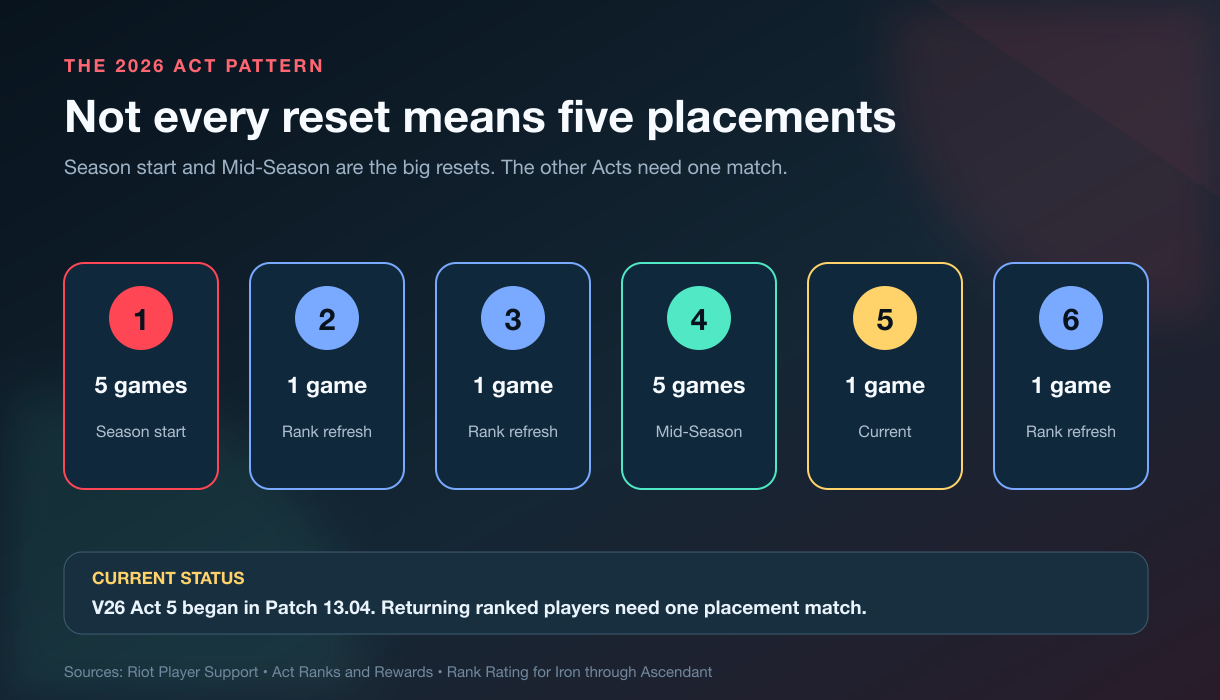
Act 5 began with Patch 13.04 on August 18{:target="_blank"}. If you played ranked earlier this year, the client should ask for one placement match before showing your Act 5 rank.
Do not confuse that placement requirement with the Act Rank badge. Your visible competitive rank can rise and fall after every match; Act Rank records your highest ranked win during the Act. Riot requires nine competitive wins in the Act to earn the badge and qualify for ranked rewards.
What resets: rank, RR, or MMR?
Players use “rank” as shorthand for three different systems. That is why reset discussions get messy.
Visible rank
Your visible rank is the badge from Iron through Radiant. Placements establish or refresh that badge, and the two five-game resets can place you lower than the rank you ended on.
Riot's current Iron-through-Ascendant placement rules{:target="_blank"} set Ascendant 3 as the highest initial placement. Ending last Act in Immortal or Radiant does not let you bypass that placement cap.
Rank Rating
RR is the visible progress inside a rank. After placement, Riot says you start with 50 RR in the rank it assigns. Reach 100 RR and you promote with at least a 10 RR buffer in the next division.
RR is not your matchmaking value. It is the progress number the client shows while the system tries to bring visible rank toward hidden MMR.
Hidden MMR
MMR is Riot's hidden matchmaking ladder. Riot does not publish your number, so no tracker can show an official exact MMR.
The current RR calculation guide{:target="_blank"} says an Act reset includes a slight MMR adjustment based on placement results. That is very different from deleting your entire history and treating the account like a first-time player.
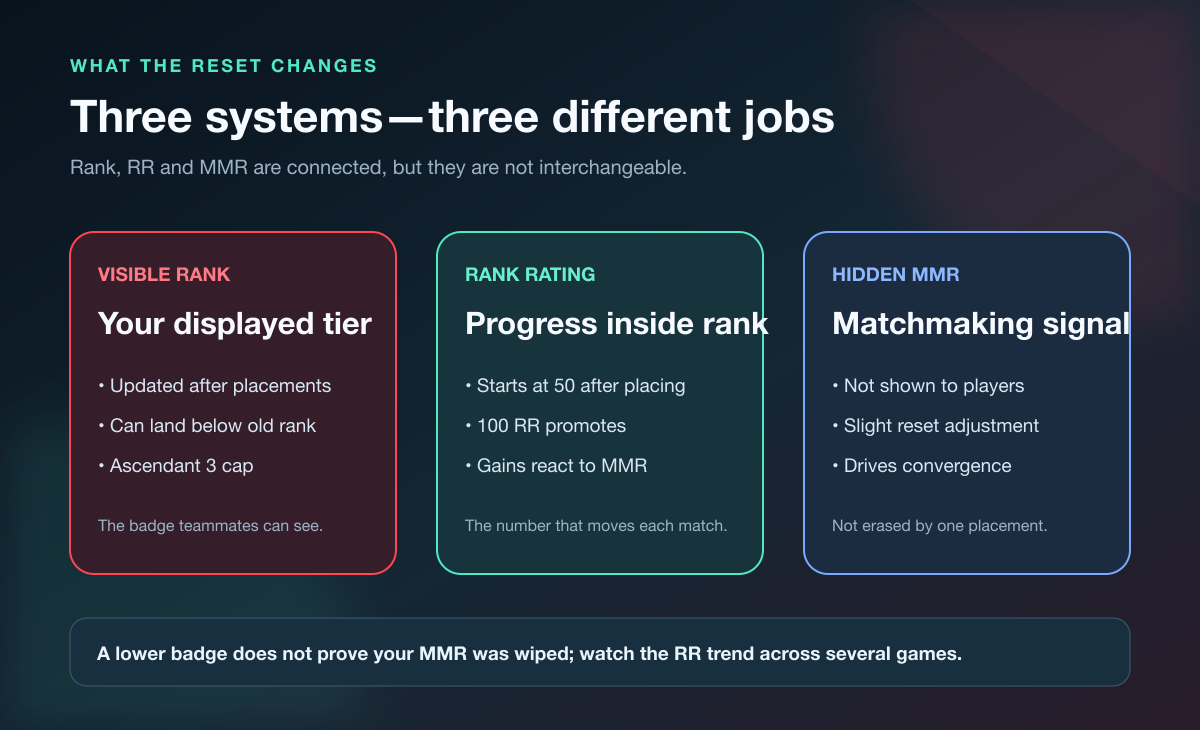
If your new badge looks lower than expected, do not diagnose the account from one result screen. Watch several wins and losses: larger gains than losses usually mean your MMR is above your rank, while smaller gains and larger losses point the other way. Our Valorant MMR guide explains that convergence without pretending a third-party site knows Riot's hidden number.
How Valorant placement games work in 2026
For the Season-start and Mid-Season resets, you complete five competitive matches before receiving a visible rank. The highest starting point is Ascendant 3.
For Acts 2, 3, 5, and 6, returning ranked players complete one placement match. That match is not a secret best-of-one promotion series; it updates the rank display using the same account context and competitive systems that already exist.
Placements are not protected exhibition games. Winning, losing, the final round margin, and your performance all feed the ranked system. Queue dodges and extended AFK behavior can also hurt RR, so “save the placement by leaving” is a bad plan.
⚠️ Watch out: Riot does not publish an exact conversion chart from your previous rank and placement score to your new badge. Any page promising “go 3–2 and you will place Gold 2” is guessing.
The right way to read a placement is as a recalibration point, not a verdict. Five games are still a tiny sample compared with the matches that produced your MMR before the reset.
How RR works after the reset
Riot lists four main inputs for RR movement:
- Match outcome: a win earns base RR; a loss removes base RR.
- Round differential: a 13–2 result moves more than a close 13–11.
- Individual performance: damage, assists, and standout play can make a smaller adjustment; K/D/A is not the whole calculation.
- Rank convergence: the system compares visible rank with hidden MMR and adjusts gains or losses.
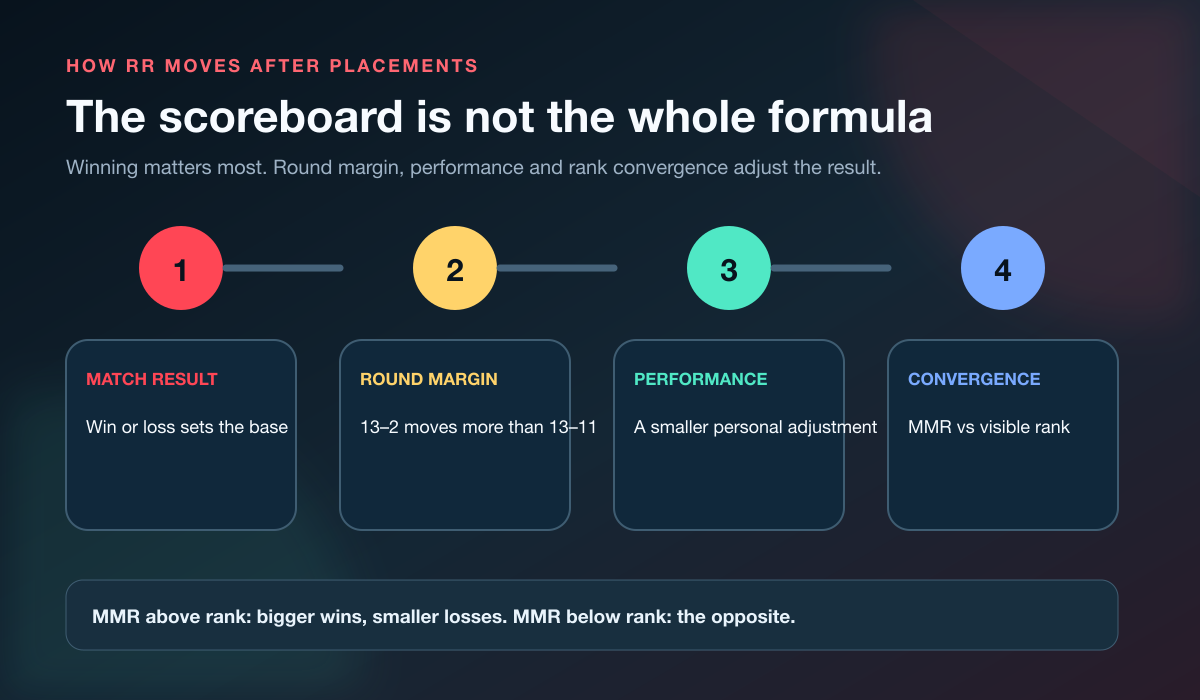
The simplest convergence read is:
- MMR above rank: wins gain more RR than losses usually remove.
- MMR near rank: gains and losses are closer.
- MMR below rank: wins gain less RR and losses remove more.
Patch 13.00 adjusted RR calculations to reduce the feeling of being stuck while consistently winning{:target="_blank"}. The patch also tightened team-average matchmaking so opposing teams are more often within one sub-tier on average.
None of that makes one top-frag a rank fix. Winning remains the largest factor, and round differential matters more than padding late kills in a lost game. If you want context for where your badge sits across the player base, use our 2026 Valorant rank distribution as a snapshot—not a promise about your next RR result.
A practical placement-session plan
You cannot control the placement formula. You can stop adding avoidable chaos to the sample.
- Warm up before queueing. Patch 13.06 added the Range while queued, but do your first movement and shooting reset before matchmaking starts so the placement is not your warm-up.
- Lock two practiced Agents. Choose a primary and a backup that cover your actual role. Reset day is a terrible time to learn a new controller because your favorite duelist got locked.
- Set two communication rules. Decide who calls the stop on a bad hit and who owns the rotate call. Two clear jobs beat constant narration.
- Review one mistake pattern. Track first deaths, untraded entries, or late rotations. Do not build a 14-stat dashboard after one match.
- Judge RR across a block. Finish placements, then look at gains and losses over several games before declaring the account cursed.
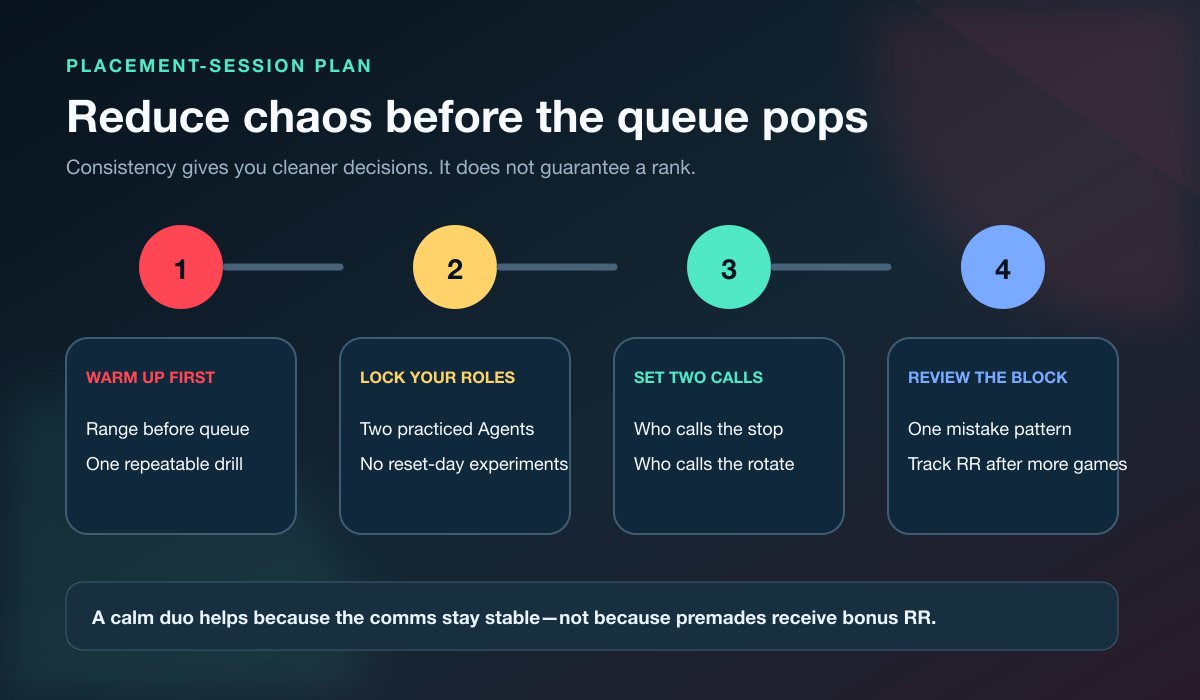
I believe the biggest duo advantage during placements is consistency. One teammate who knows your Agent pool and comms gives you fewer variables to solve between rounds; Riot does not award bonus RR just because you queued together.
If your old duo is gone or you want structured feedback before the next block, find a Valorant coach or teammate on Tapin. Ask for role fit, calm comms, and honest review—not a guaranteed rank. Our Valorant duo partner guide has a quick screening process for finding someone you can actually queue with more than once.
Valorant rank reset FAQ
How many Valorant placement games are there after a reset?
You play five placements at Season start in Act 1 and at Mid-Season in Act 4. Acts 2, 3, 5, and 6 require one placement match for returning ranked players.
Does Valorant reset rank every Act?
Riot calls each Act opening a rank reset, but the impact differs. Acts 1 and 4 use five placements; the other Acts use one, and your rank does not automatically drop merely because an ordinary new Act began.
Does hidden MMR reset in Valorant?
It is adjusted, not wiped clean. Riot says placement results create a slight MMR adjustment at an Act reset, while your hidden rating continues to drive matchmaking and RR convergence.
What is the highest rank you can place in 2026?
Ascendant 3 is the highest initial placement under Riot's current Iron-through-Ascendant rules. Players above that point must climb back through normal RR after placing.
Why did I place lower but still face high-ranked players?
Visible rank and hidden MMR are different. A lower placement badge can sit below your matchmaking level, which usually shows up as larger RR gains on wins and smaller losses while rank converges upward.
The 2026 system is easier once you separate the two reset sizes: five games in Acts 1 and 4, one game in the other Acts, and no clean-slate MMR wipe. Prepare a small Agent pool, keep your comms steady, and read the RR trend after the placement—not the panic in the first post-game screen.