
Last Updated: August 2026
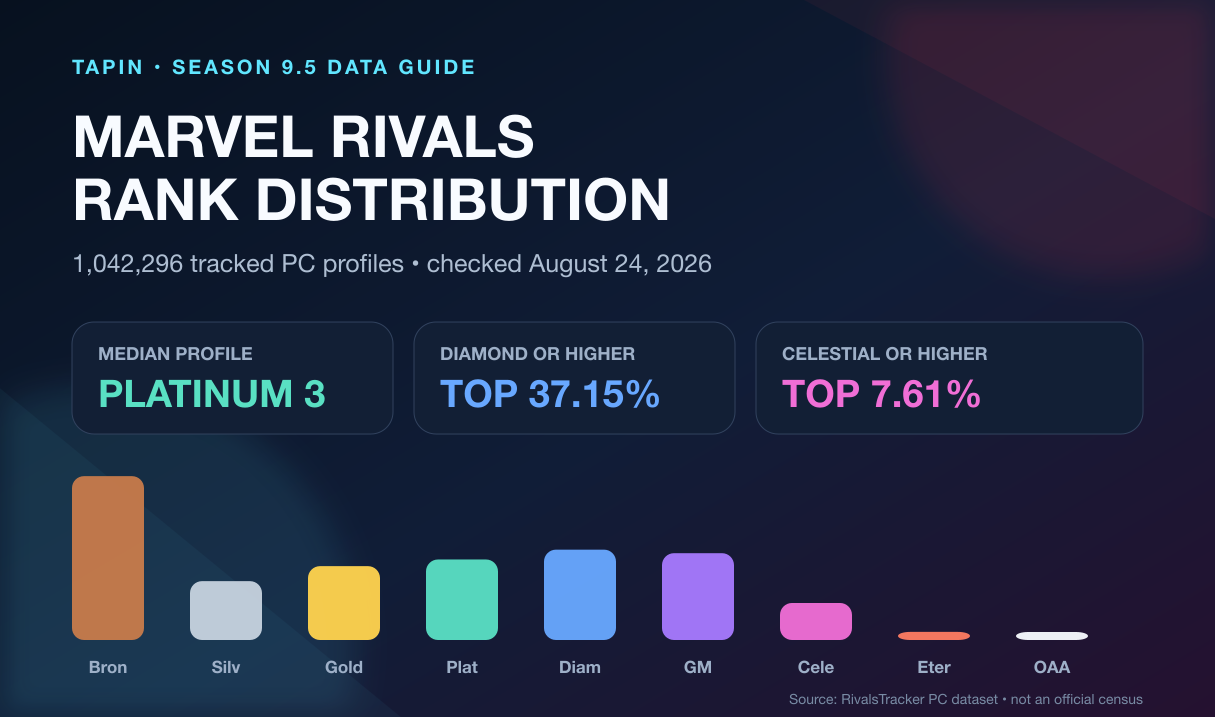
Bronze is the biggest Marvel Rivals tier in the current tracker sample, but the median tracked profile lands in Platinum 3. Diamond or higher represents the top 37.15%, while Celestial or higher narrows the field to the top 7.61%.
This Marvel Rivals rank distribution guide uses a live Season 9.5 PC snapshot. You’ll get every tier percentage, the useful percentile cutoffs, and an honest explanation of what this data can—and can’t—say about your skill.
⚡ Quick answer: Bronze contains 27.31% of tracked profiles. Platinum or higher is the top 50.57%, Diamond or higher is the top 37.15%, Grandmaster or higher is the top 22.08%, and Celestial or higher is the top 7.61%.
Your badge gives you context. It does not tell you whether you keep burning an ult into a lost fight, chasing past your frontline, or missing the same peel call every round. A consistent duo makes those mistakes easier to spot because the role split and comms stop changing every match.
Table of Contents
- Marvel Rivals rank distribution in Season 9.5
- What is the average Marvel Rivals rank?
- Marvel Rivals rank percentiles explained
- Why the distribution looks unusual
- What each rank should work on next
- How current is this data?
- FAQ
Marvel Rivals Rank Distribution in Season 9.5
The table comes from RivalsTracker’s Season 9.5 rank dataset, checked August 24, 2026. Its displayed subrank counts add up to 1,042,296 PC profiles. We summed those subranks into tiers and calculated “tier or higher” from the same snapshot.
| Rank tier | Share of profiles | This tier or higher |
|---|---|---|
| Bronze | 27.31% | Top 100% |
| Silver | 9.81% | Top 72.69% |
| Gold | 12.31% | Top 62.88% |
| Platinum | 13.42% | Top 50.57% |
| Diamond | 15.06% | Top 37.15% |
| Grandmaster | 14.47% | Top 22.08% |
| Celestial | 6.17% | Top 7.61% |
| Eternity | 1.35% | Top 1.44% |
| One Above All | 0.09% | Top 0.09% |
The percentages are calculated from the displayed profile counts, then rounded to two decimals. That keeps the tier totals and cumulative cutoffs on one consistent base.
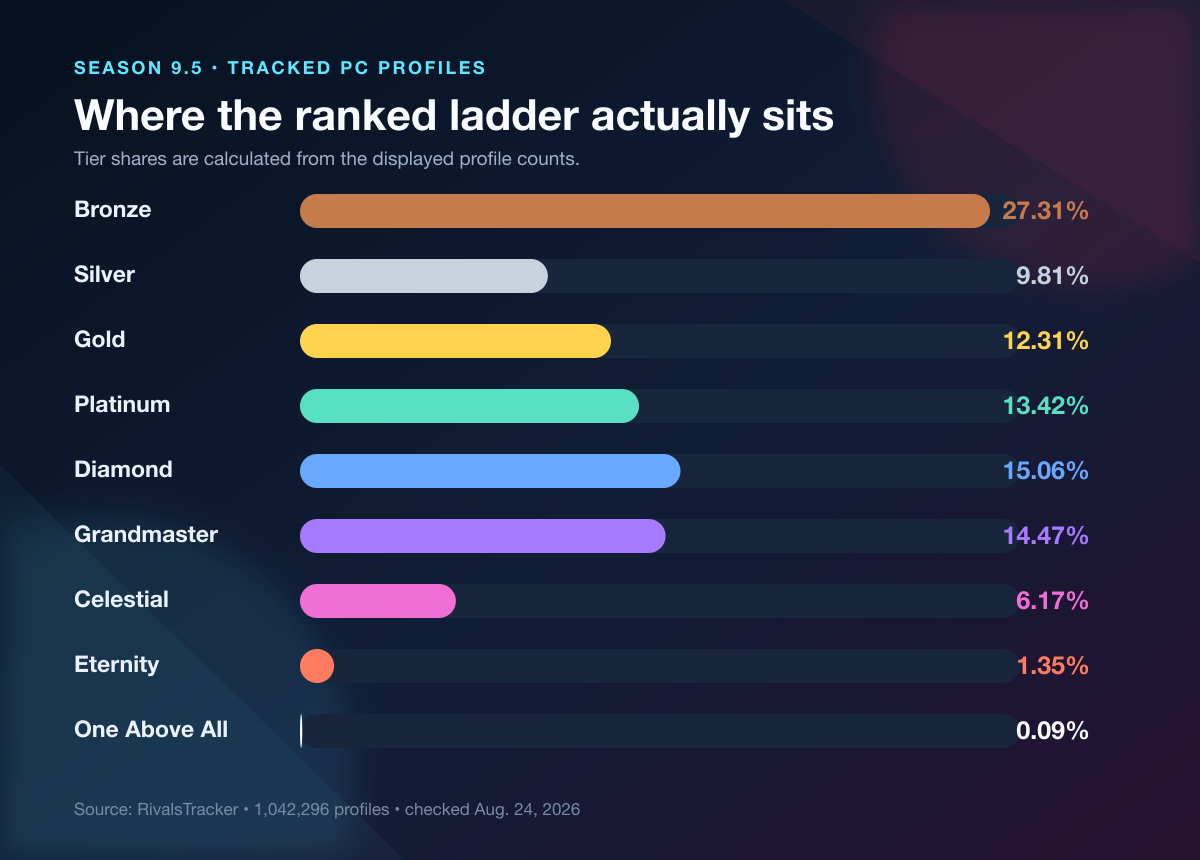
Bronze is the largest tier because Bronze 3 alone holds 19.38% of the sample. Grandmaster is also unusually wide at 14.47%, with Grandmaster 3 accounting for 7.80% by itself.
Those numbers sound strange if you expect every ranked ladder to form a smooth bell curve. The correct response is not to massage them into something prettier. This is what the live tracker reports, and the sample limits matter.
What Is the Average Marvel Rivals Rank?
“Average rank” can mean two different things here.
The most common subrank is Bronze 3 at 19.38%. The median tracked profile sits in Platinum 3: Bronze through Gold make up 49.43% of the sample, and Platinum 3 carries the cumulative total past 50%.
So the clean answer is:
- Mode: Bronze 3
- Median: Platinum 3
- Most common full tier: Bronze
I believe median is the more useful comparison. It answers the question most players actually mean: “What rank sits in the middle of this dataset?” Calling Bronze or Platinum the single “average” without defining the statistic just creates arguments.
⚠️ Watch out: Platinum 3 is the median of this tracked PC dataset, not a proven median for every Marvel Rivals player across PC and console.
Marvel Rivals Rank Percentiles Explained
The third table column means that tier and every tier above it. A Diamond player is inside the top 37.15% of tracked profiles; that does not mean Diamond itself contains 37.15%. Diamond’s own share is 15.06%.
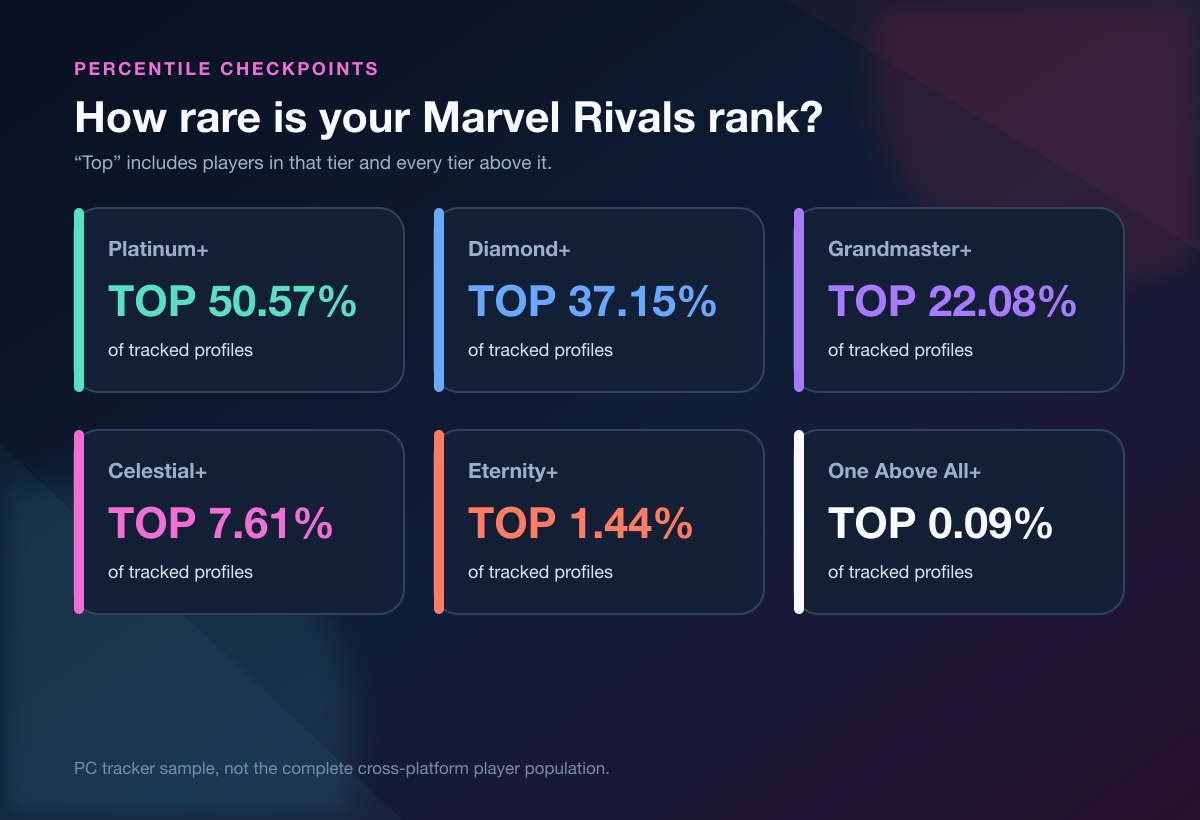
The checkpoints worth remembering are:
- Platinum or higher: top 50.57%
- Diamond or higher: top 37.15%
- Grandmaster or higher: top 22.08%
- Celestial or higher: top 7.61%
- Eternity or higher: top 1.44%
- One Above All: top 0.09%
Division matters inside every tier. Diamond 3 and Diamond 1 share a tier label, but Diamond 1 sits above another 10.91% of the dataset when Diamond 3 and Diamond 2 are counted together.
Use the tier cutoffs for a fast answer. Use the full subrank table when you want a more precise comparison.
Why the Distribution Looks Unusual
RivalsTracker says this chart describes profiles in its PC dataset, not an official census of the complete Marvel Rivals population. That distinction is doing real work.
Three limits change how you should read it:
- Coverage: untracked players are not represented.
- Platform: the page labels the dataset PC, so it should not be treated as a console distribution.
- Timing: promotions, demotions, placements, and new profiles keep moving the percentages during the season.
The large Bronze 3 and Grandmaster 3 bars are observations. The tracker page does not prove one neat cause for either spike, so we are not inventing one.
This also explains why another article may show different numbers. A July snapshot, an August snapshot, and a cross-platform estimate are three different datasets. Compare the source, date, and platform before comparing decimals.
What Each Rank Should Work On Next
Percentile is not a diagnosis. Two Platinum players can hold the same badge for opposite reasons: one wins duels and wastes advantages, while the other makes clean calls but loses every isolated fight.
Start with one likely leak, then prove it in review.
| Rank band | Review focus | Duo practice |
|---|---|---|
| Bronze–Silver | Regroup timing, avoidable deaths, one reliable role | Call the target and retreat before every commit |
| Gold–Platinum | Ult economy, target priority, objective setup | Plan one engage and one disengage call per fight |
| Diamond–Grandmaster | First lost advantage, cooldown tracking, adaptation | Review the first fight where a lead disappeared |
| Celestial+ | Map-specific plans, opponent tendencies, tiny edge conversion | Build short protocols for opening fights and overtime |
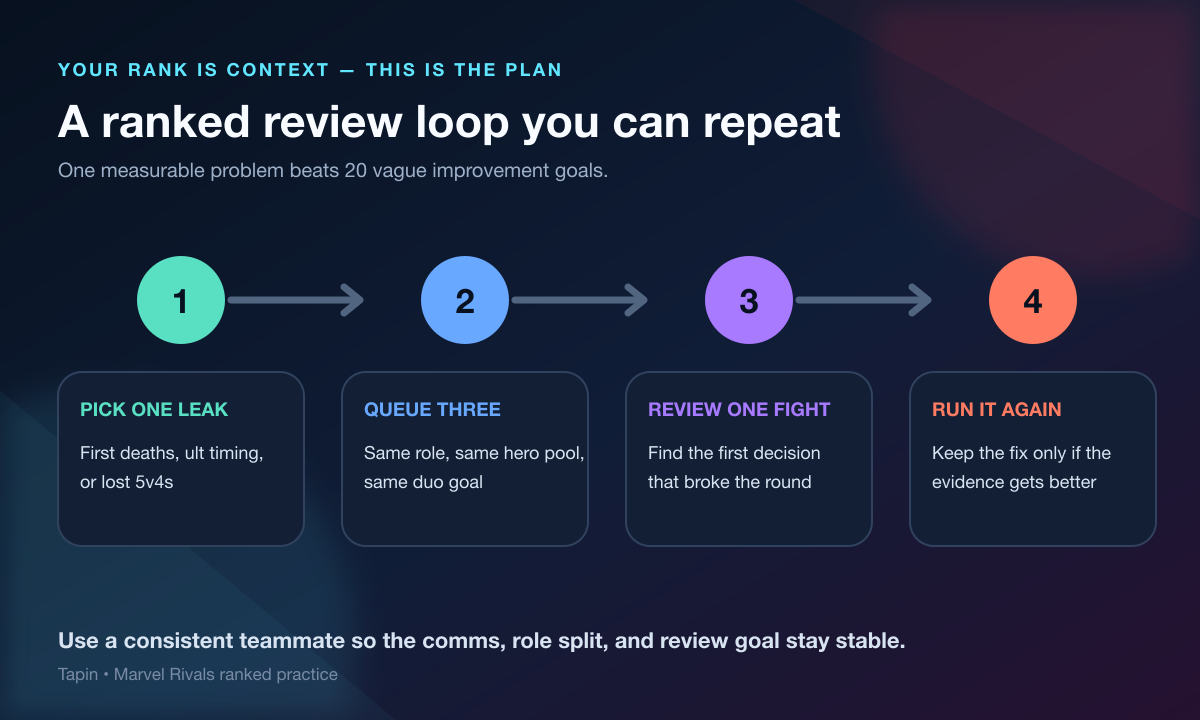
The loop is simple: pick one leak, play three games, review one fight, then run the test again. If the evidence gets better, keep the fix. If it does not, change the diagnosis.
Solo queue makes that process noisy because every match can hand you a new role split and a new communication style. Find a Marvel Rivals teammate on Tapin if you want the same duo goal across a full session instead of rebuilding coordination every queue.
For a broader climb plan, use our seven practical Marvel Rivals ranked tips. Newer players can start with the Marvel Rivals beginner guide, then move into the Team-Up combo guide once the roles feel natural.
How Current Is This Data?
This article was checked on August 24, 2026. The official Season 9.5 update launched August 7, and the latest live release is Version 20260820.
The August 20 notes list hero bug fixes and store content, not a new rank-distribution table. NetEase does not publish the live percentages used here; the numbers remain a third-party tracker snapshot and should move as the dataset refreshes.
We will treat the table as stale when the source changes materially, the season rolls over, or its platform coverage changes. Until then, the date and method matter more than fake precision.
Marvel Rivals Rank Distribution FAQ
What is the average Marvel Rivals rank in 2026?
The median tracked profile is Platinum 3 in the August 24 Season 9.5 PC snapshot. Bronze 3 is the most common individual subrank, so “average” changes depending on whether you mean median or mode.
What percentage of Marvel Rivals players are Diamond?
Diamond contains 15.06% of tracked profiles. Diamond or higher—including Grandmaster, Celestial, Eternity, and One Above All—represents the top 37.15% of this dataset.
How rare is Grandmaster in Marvel Rivals?
Grandmaster itself contains 14.47% of the tracker sample. Grandmaster or higher is the top 22.08%, which is why this PC dataset should not be confused with a full cross-platform census.
What percentage of players reach Celestial?
Celestial contains 6.17% of tracked profiles. Celestial or higher is the top 7.61% after Eternity and One Above All are included.
Is this Marvel Rivals rank distribution official?
No. It is calculated from RivalsTracker’s Season 9.5 PC dataset. The official Marvel Rivals site confirms the current season and patch, but it does not provide the live population percentages in this table.
Your Rank Is Context, Not the Plan
The Season 9.5 sample puts the median tracked profile in Platinum 3, Diamond or higher in the top 37.15%, and Celestial or higher in the top 7.61%. Useful context—nothing more.
Pick one repeated mistake, keep your role and teammate variables stable, and test the fix over the next three games.