
Last Updated: August 2026
Your badge says Gold. Your lobbies look Platinum. Your LP gains change from one night to the next. It feels random until you separate League of Legends MMR from rank and LP.
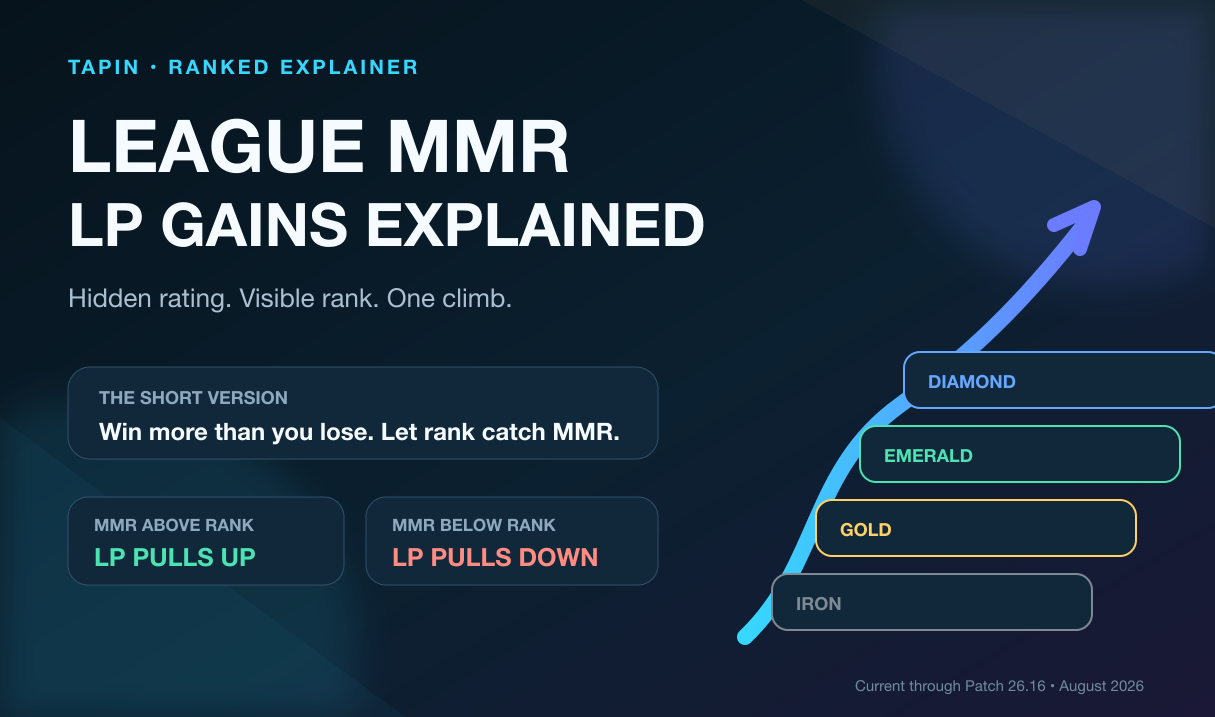
MMR is Riot's hidden estimate of your skill. Rank is the badge you see. LP is the system that moves that visible rank toward the hidden rating. If MMR sits above your rank, wins usually pay more than losses cost. If MMR sits below it, the pattern usually flips.
Current status: This guide was checked during Season 3 on live Patch 26.16{:target="_blank"}. The ranked rules below come from Riot's current support pages, not an unofficial MMR calculator.
| Your MMR vs rank | Usual LP pattern | What it means |
|---|---|---|
| MMR is higher | Gain more than you lose | Rank is catching up |
| MMR is close | Gains and losses are similar | Rank and MMR are aligned |
| MMR is lower | Gain less than you lose | Rank is correcting downward |
Table of contents
- How League of Legends MMR works in 2026
- MMR vs LP in League of Legends
- Why you gain less LP than you lose
- What changed in Ranked during 2026
- Can an MMR checker show your real rating?
- How to improve MMR without chasing tricks
- FAQ
How League of Legends MMR works in 2026
Riot's current MMR explainer{:target="_blank"} keeps the core rule simple: win and your MMR rises; lose and it falls. Riot uses that hidden rating to place you with players it considers similarly skilled.
The exact number stays secret. Riot says the rating only makes sense inside its matchmaking systems, so exposing one raw value would strip away context. That is why your profile shows a tier, division, and LP instead.
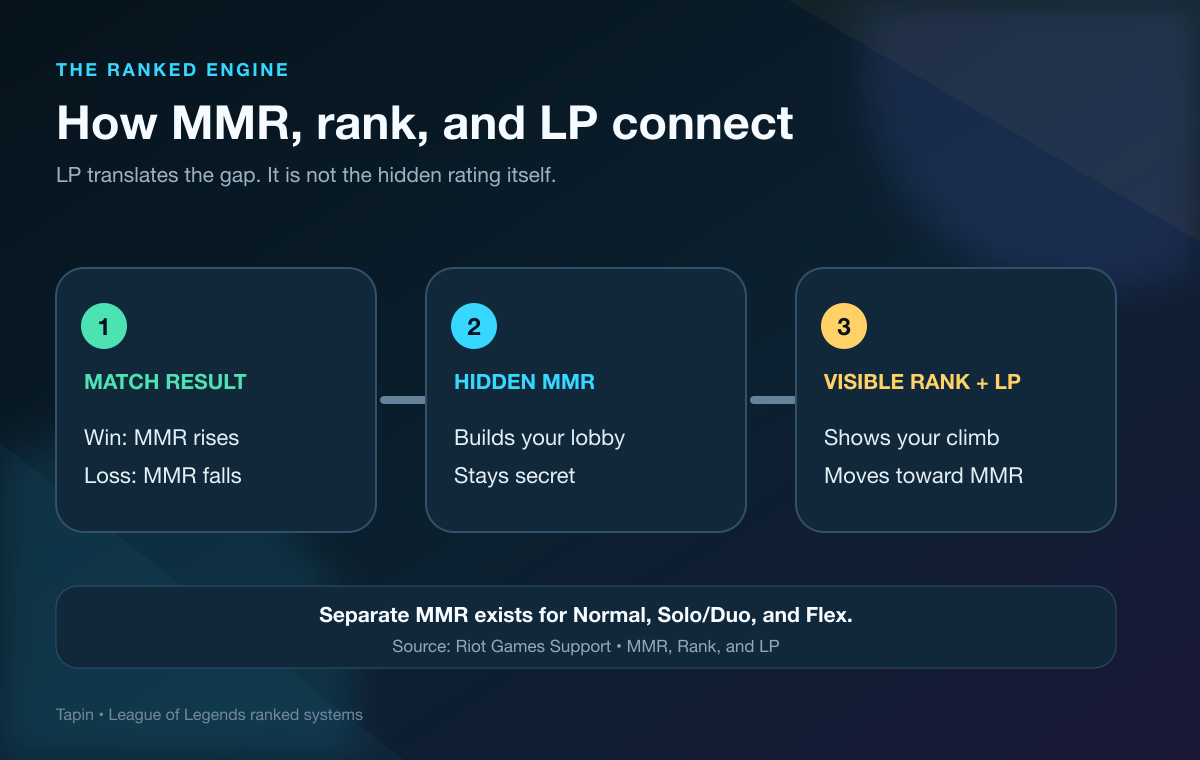
MMR also belongs to a queue. Normal, Solo/Duo, and Flex each keep separate ratings. A miserable Flex streak does not directly tank your Solo/Duo MMR, and farming Normal wins does not repair an established Ranked rating.
There is one early-account connection: Riot says Normal MMR can inform an account's initial Ranked placement. Once you are climbing, judge the queue you actually play.
Duo reality: A partner does not give you free MMR. The advantage is repeatable comms, role coordination, and review with someone who remembers the plan. Riot accounts for premade coordination when it builds the lobby.
Matchmaking uses MMR, not the border in loading screen
Riot defines a fair match as one where each team has roughly a 50% ±1% chance to win, built around similar average MMR. Visible ranks can still look strange because a badge may lag behind the hidden rating.
That is exactly why Riot added the Climb Indicator in 2026. A Silver player appearing in a Platinum-looking lobby may be climbing late after the yearly reset rather than being wildly misplaced.
Your lobby can still feel uneven. Off-roles, unfamiliar champions, snowballing, queue population, and uneven playstyles are not fully captured by one pre-game estimate. Fair odds do not promise a close final score.
MMR vs LP in League of Legends
Think of MMR as the engine and LP as the dashboard. They are connected, but they are not interchangeable.
When the hidden system believes you belong above your visible rank, LP accelerates the badge upward. When it believes your badge is ahead, LP applies more downward pressure. When both systems agree, gains and losses settle closer together.
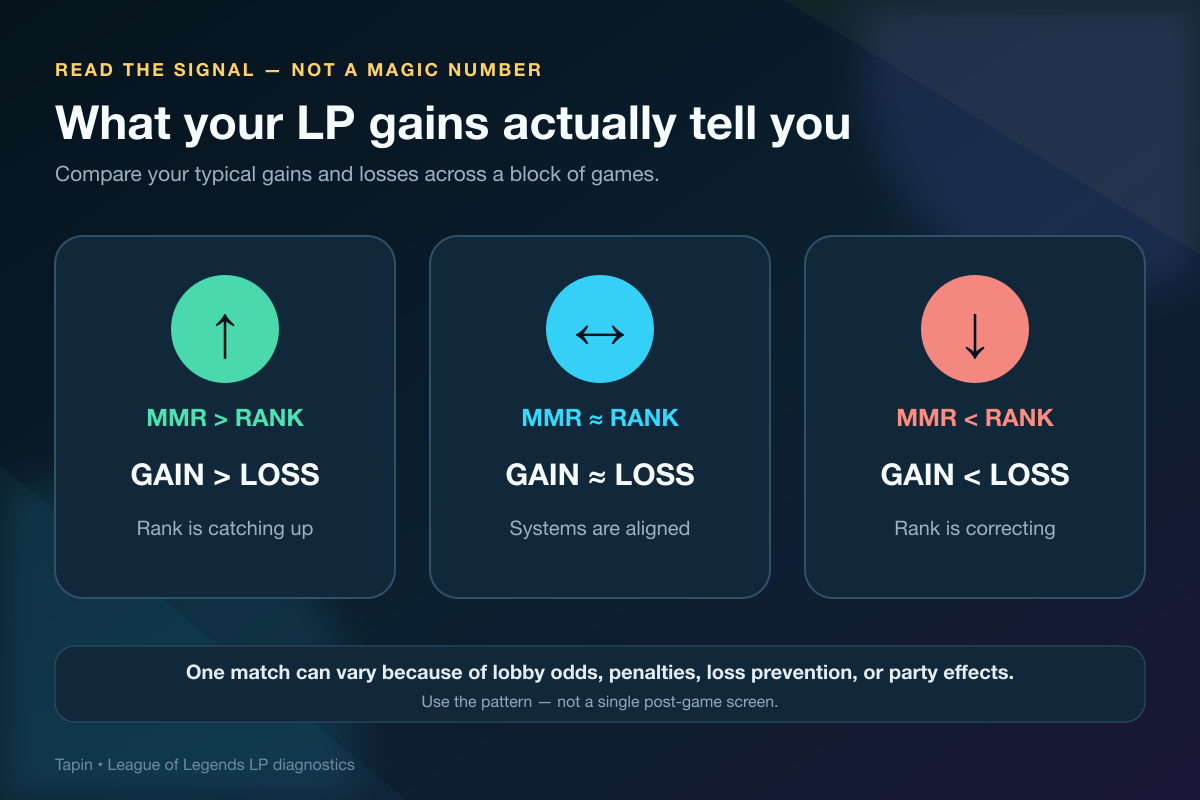
Do not diagnose your account from one post-game screen. Riot lists several reasons an individual result can differ from your usual pattern:
- one team had slightly different pre-game win odds;
- loss prevention was active because of a system issue;
- an AFK or leaver penalty changed your LP;
- you received Consolation LP after a verified disruptive teammate;
- your party changed the matchmaker's calculation;
- Aegis of Valor doubled LP on an eligible win.
The useful signal is your typical gain-versus-loss relationship across a block of games. One weird result is noise. A repeated pattern tells you whether visible rank is chasing MMR, aligned with it, or being pulled back.
LP is not a performance grade
Riot's public MMR rules define movement by match result. They do not promise extra MMR because your KDA, damage, or vision score looked good.
Personal performance matters because it changes your chance to win. That is a massive difference. Chasing a clean scoreboard while giving away Baron is not an MMR strategy.
Why you gain less LP than you lose
If you keep asking, “Why do I gain less LP?”, the most likely system-level answer is that your visible rank sits above your current MMR. A cold streak can open that gap, especially if your badge has not dropped as quickly as the hidden rating.
The repair is boring because it is real: win more than you lose at your current matchmaking level. As the rating and badge move back together, the LP relationship can normalize.
Do not trust anyone selling a fixed number of wins that will “repair” an account. Riot does not publish the formula, the exact gap, or a guaranteed recovery schedule. Opponent strength and your existing uncertainty can change how quickly the systems converge.
⚠️ Watch out: A fresh account, server transfer, or annual placement climb can behave differently from an established account. Do not compare your LP to a friend's without matching account history and queue context.
If the badge itself is confusing, use our League of Legends rank distribution guide to see where each tier sits after Riot's 2026 distribution changes.
What changed in Ranked during 2026
The core win/loss relationship did not disappear, but Riot changed the systems around it.
Riot recalibrated MMR-to-rank distribution
In its 2026 MMR-to-rank distribution update{:target="_blank"}, Riot said Iron had accumulated too many experienced players. It shifted more of that population toward Bronze so Iron could better serve genuinely new competitors.
Riot also moved the upper end of Diamond's MMR range toward Master. That widened Master and pushed Grandmaster and Challenger LP cutoffs higher even though those tiers still contain limited player counts.
This changes what badges represent across the ladder. It does not make an unofficial checker more accurate, and it does not mean every player received free MMR.
Season 3 continued the yearly climb
Patch 26.15 launched Season 3{:target="_blank"} on July 29. League's current structure has three seasons inside one Ranked year, with progress continuing between them. The main ladder reset happens with the new year, not every seasonal theme.
Aegis of Valor became win-only
Aegis originally mixed LP protection with performance requirements. Season 3 removed that conflict: an active Aegis now awards double LP only on a win, with no minimum Mastery grade and no loss protection.
Riot's current autofill page{:target="_blank"} also says the bonus is occasional, can appear for priority roles, and is not guaranteed every autofilled game. Treat it as an LP exception, not proof your hidden MMR doubled.
Duoing has its own matchmaking context
Riot says a premade carries communication and coordination advantages, so matchmaking accounts for the party. That can mean stronger opponents or reduced LP in some games.
As of Season 3, Master players can duo only within tighter rank limits; Grandmaster, Challenger, and players with those MMRs cannot. Check our current League duo rank restrictions before planning an Apex climb.
Can a League of Legends MMR checker show your real rating?
No public League of Legends MMR checker can show Riot's exact hidden number. Riot calls MMR secret. A third-party site can only estimate from information it can observe.
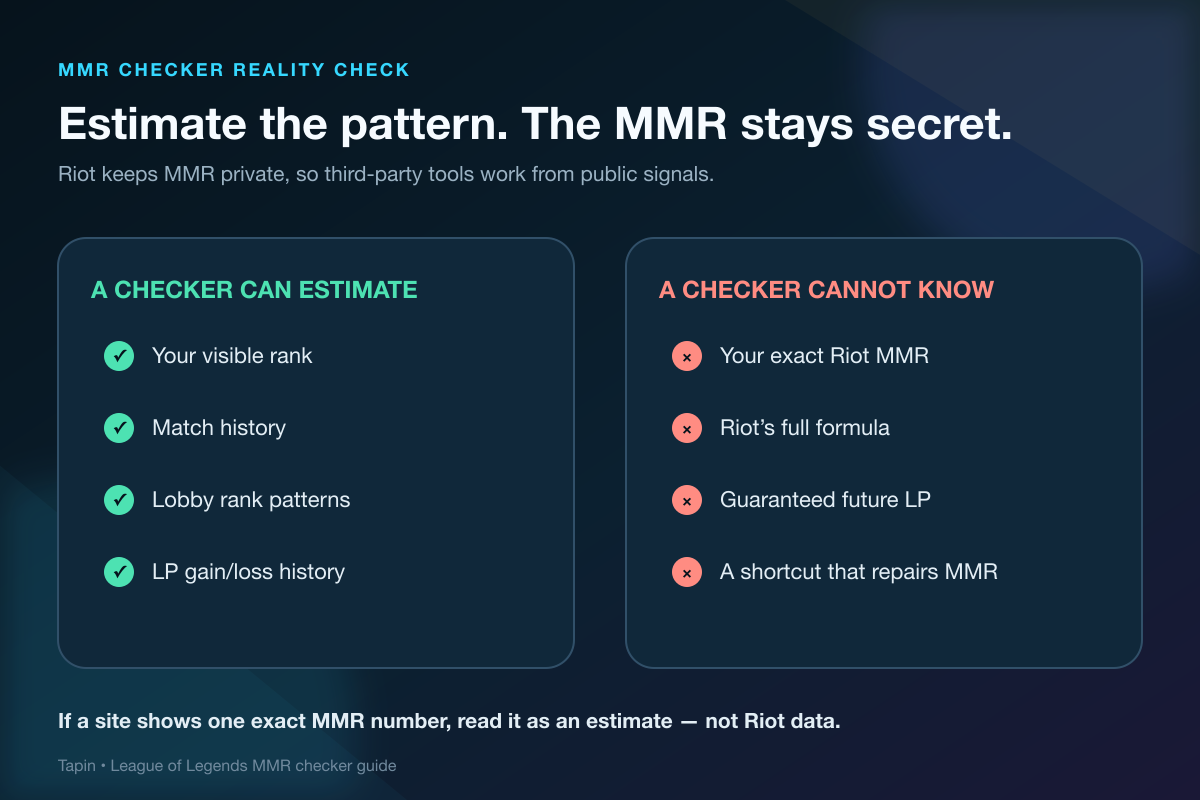
A reasonable checker may summarize:
- your visible rank and match history;
- the ranks commonly appearing in your games;
- recent LP gains and losses you provide;
- whether your visible badge seems behind or ahead of lobby level.
It cannot verify Riot's internal rating, formula, uncertainty, or next-game LP. If a tool prints “1,742 MMR,” read that as the site's model output—not a number pulled from Riot's matchmaker.
I believe the safest checker is your own 15-to-20-game log. Record queue, result, LP change, role, and whether an exception appeared. That will not reveal secret MMR, but it will show the only trend you can act on.
How to improve MMR without chasing tricks
You do not need an MMR hack. You need a cleaner sample of games and fewer self-inflicted variables.
- Lock one role and two champions. Role swaps and constant first-timing make it harder to identify the decisions costing wins.
- Play four blocks of five games. Stop the block if tilt changes how you draft, communicate, or take fights.
- Review one repeated leak. First death, missed objective setup, bad recall, or late-game positioning—pick one, not 12.
- Apply one fix in the next block. If it does not change the game state you care about, replace it.
- Track wins and LP patterns separately. Wins move the climb; LP tells you how visible rank relates to hidden MMR.
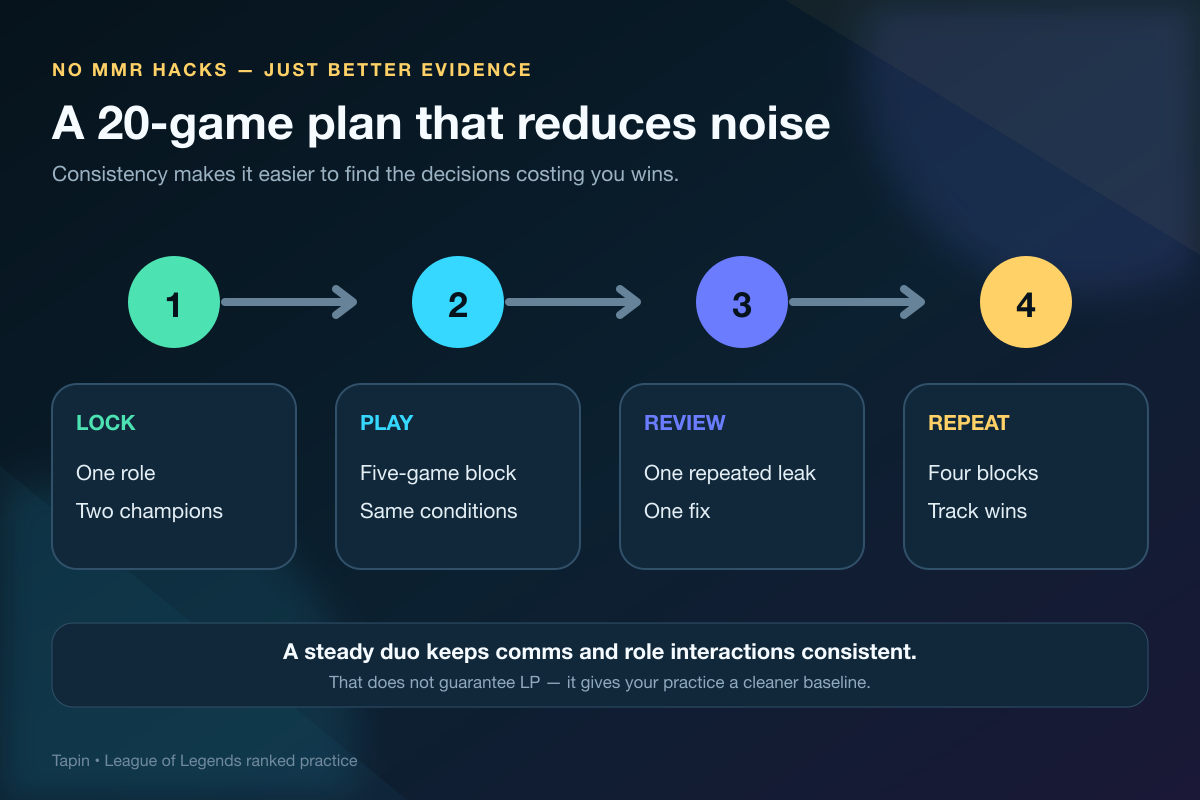
A steady duo can make this process easier because comms, role interactions, and review goals stay consistent. The matchmaker accounts for premade advantage, so a duo is not free LP. The value is having someone who remembers what you were practicing after the last loss.
If your friends list is empty or your old duo quit, work through the climb with a League coach or duo on Tapin. Pick someone who fits your role pair and communication style, then run the same 20-game process instead of turning every queue into a new experiment.
Our League duo queue guide covers the role pairs, comms, and review habits that make coordinated practice useful without pretending it guarantees a rank.
League of Legends MMR FAQ
Can I see my exact League of Legends MMR?
No. Riot keeps MMR secret and does not expose an official exact value. Checkers can estimate from public signals, but their number is not Riot's internal rating.
Why do I gain less LP than I lose?
Across a repeated block of games, that pattern usually means your visible rank is above your MMR. One result can also be affected by lobby odds, penalties, loss prevention, party effects, or an LP bonus.
Does KDA affect MMR in League of Legends?
Riot's public explanation ties MMR direction to winning and losing, not a published KDA formula. Better play raises your win probability; a prettier scoreboard does not come with a promised MMR bonus.
Does duo queue change your MMR?
Solo/Duo uses one queue-specific MMR, and wins or losses still move it. Riot accounts for premade coordination when building games, so a duo may face adjusted opponents or LP outcomes rather than receiving free rating.
Can Normal games fix Ranked MMR?
No. Normal, Solo/Duo, and Flex maintain separate MMRs. Normal MMR can help seed an account's first Ranked placement, but Normal wins do not directly repair an established Solo/Duo rating.
MMR is hidden, but its relationship with rank is readable. Watch the gain/loss pattern, build a consistent block of games, and judge the climb by decisions that create wins—not by a checker claiming it found Riot's secret number.